
Overview
The nalanda package helps researchers work with large language models from R. It supports structured prompting workflows, simulation studies, and LLM-based text analysis with outputs that are easy to inspect, summarize, and plot.
Two common use cases are:
- psychological text analysis, where models annotate or score text data row by row
- simulation workflows, where models are prompted as synthetic respondents across repeated scenarios
A central goal of the package is to support different experimental designs in LLM-based research, including between-group designs, post-only designs, within-subject pre-post designs, mixed designs, and longitudinal or repeated-turn interactions.
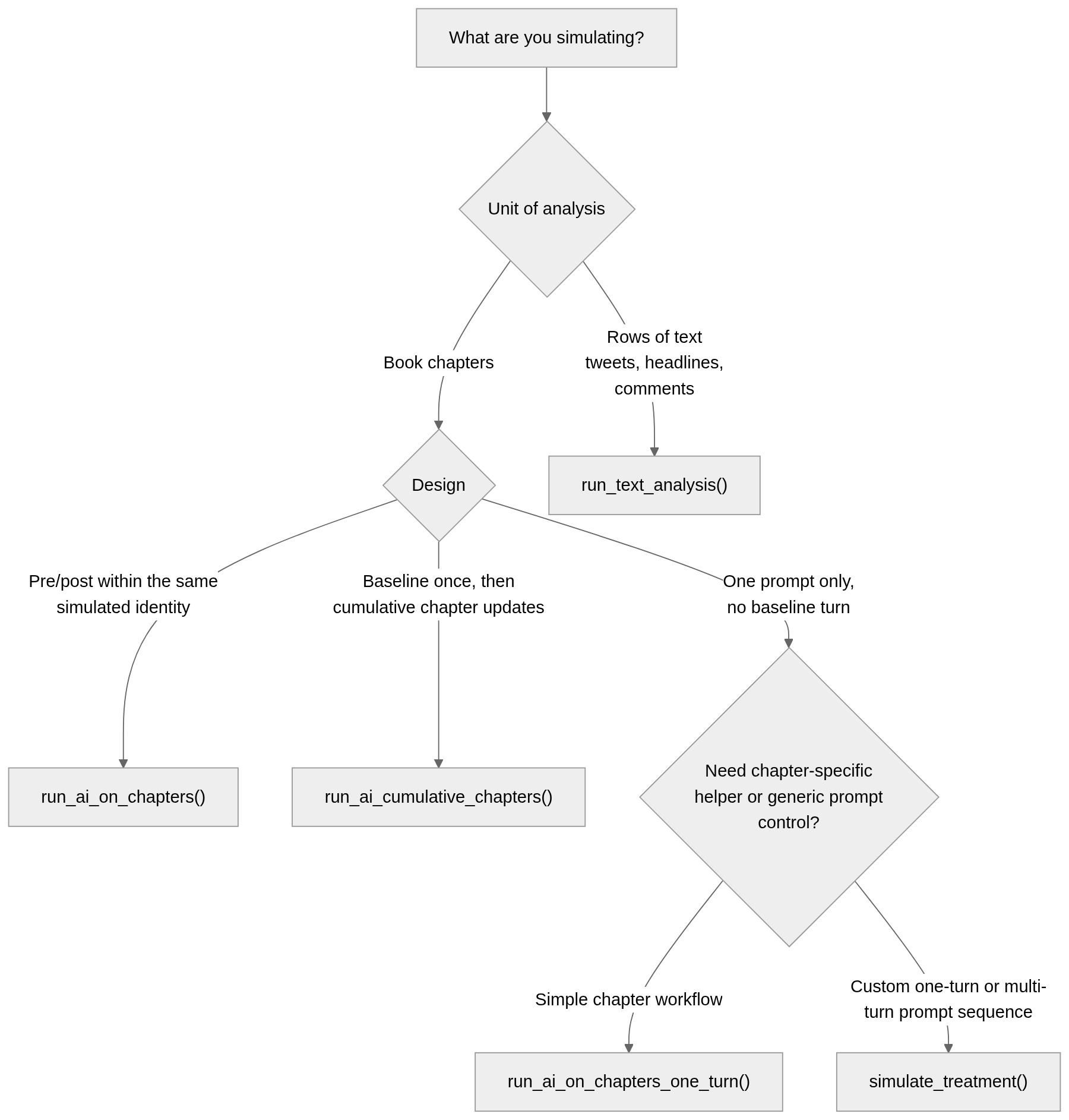
One motivating application is the study of whether books change attitudes and social judgments. In that setting, nalanda can simulate chapter-level responses, summarize shifts in ingroup and outgroup ratings, and visualize change across chapters or whole books. The simulation workflow figure below highlights the main chapter-based entry points.
Installation
You can install the development version of nalanda from GitHub with:
install.packages(
  'nalanda', repos = c(
    'https://centerconflictcooperation.r-universe.dev',
    'https://cloud.r-project.org'))
Example workflows
If you want to run the live minimal example below, first set your Portkey-compatible API key in .Renviron (for example, PORTKEY_API_KEY=...) and see the getting started tutorial for the full setup.
Note: NYU users can request an NYU Portkey API key at
Genai-research-support@nyu.edu.
Run this setup once before either workflow (the example below is for the NYU Portkey integration):
library(nalanda)

options(
  nalanda.integration = "vertexai",
  nalanda.base_url = "https://ai-gateway.apps.cloud.rt.nyu.edu/v1/"
)
Minimal prompt-first example with simulate_treatment()
res <- simulate_treatment(
  intervention_text = "A short community message encourages people from different backgrounds to cooperate on a shared local goal.",
  groups = c("American", "Brazilian"),
  context_text = "You are simulating an adult who identifies as {identity}.",
  prompt = "{intervention_text}

On a scale from 0 to 100, how much do you support this message?",
  response_type = ellmer::type_object(
    support = ellmer::type_number()
  ),
  n_simulations = 2,
  temperature = 0,
  model = "gemini-2.5-flash-lite"
)

res| treatment | sim | identity | turn_index | turn_type | support |
|---|---|---|---|---|---|
| intervention_1 | 1 | American | 1 | turn_1 | 78 |
| intervention_1 | 2 | American | 1 | turn_1 | 76 |
| intervention_1 | 1 | Brazilian | 1 | turn_1 | 71 |
| intervention_1 | 2 | Brazilian | 1 | turn_1 | 69 |
Chapter-level example with run_ai_on_chapters()
For chapter-based pre/post simulations, the main workflow is:
- run
run_ai_on_chapters()to get raw turn-level output - convert the raw turns to chapter-level metrics with
compute_run_ai_metrics() - plot or summarize the processed results
raw_turns <- run_ai_on_chapters(
  book_texts = "A short chapter about people from different groups cooperating.",
  groups = c("Democrat", "Republican"),
  context_text = "You are simulating an American adult who politically identifies as a {identity}.",
  question_text = "On a scale from 0 to 100, how warmly do you feel towards {group}s?",
  n_simulations = 2,
  temperature = 0,
  model = "gemini-2.5-flash-lite"
)

chapter_results <- compute_run_ai_metrics(raw_turns)
Multi-model structured forecasting
run_structured_responses() is the neutral one-model, one-prompt primitive; run_text_analysis() remains its text-annotation-oriented wrapper.
For row-wise studies that cross several prompt variants with several model routes, use plan_prompt_grid() to validate the configuration and preview response counts, then run_prompt_grid() for provenance, per-completion checkpoints, and resume support. Keep the raw results before using aggregate_model_forecasts() to apply an explicit completion → prompt → model → family weighting hierarchy. See the multi-model structured forecasting tutorial.
library(nalanda)

img_paths <- list(
  Democrat = normalizePath("man/figures/dem.png"),
  Republican = normalizePath("man/figures/rep.png")
)

chapter_results <- compute_run_ai_metrics(toy_run_ai_turns)

head(chapter_results[, c("book", "chapter", "sim", "party", "delta_gap")])| book | chapter | sim | party | delta_gap |
|---|---|---|---|---|
| Bridge Stories | chapter_1 | 1 | Democrat | 3.0 |
| Common Ground | chapter_1 | 1 | Democrat | 4.0 |
| Bridge Stories | chapter_1 | 1 | Republican | 11.0 |
| Common Ground | chapter_1 | 1 | Republican | 5.0 |
| Bridge Stories | chapter_1 | 2 | Democrat | 3.5 |
| Common Ground | chapter_1 | 2 | Democrat | 4.5 |
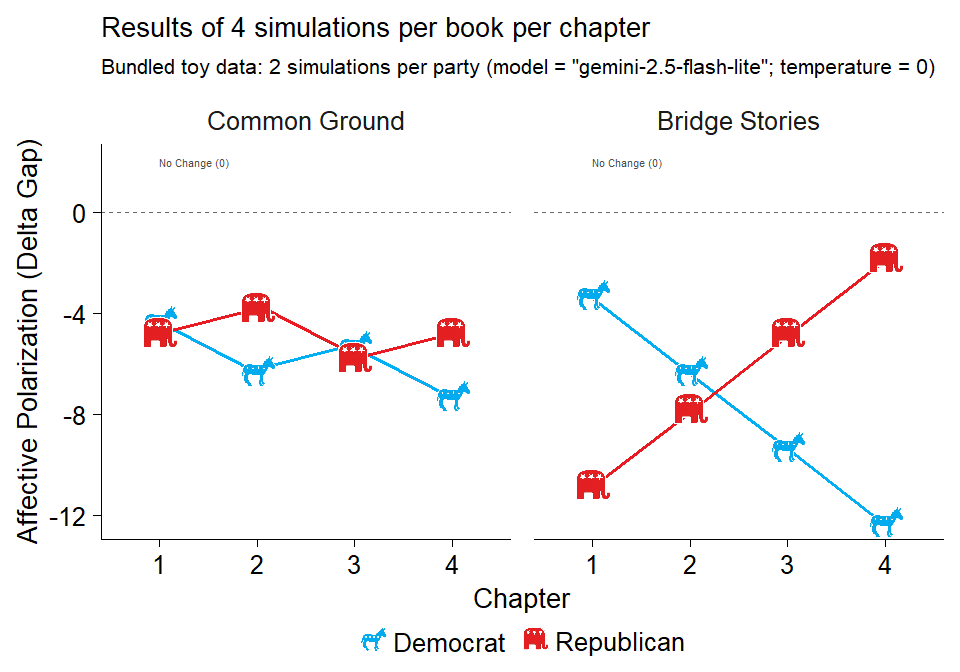
Use the processed chapter-level results directly with the time-series plotting helper:
plot_chapters_over_time(
  chapters = chapter_results,
  dv = "delta_gap",
  group = "party",
  y_label = "Affective Polarization (Delta Gap)",
  plot_subtitle = "Bundled toy data: 2 simulations per party",
  plot_title = "Results of 4 simulations per book per chapter",
  error_bars = FALSE,
  reverse_score = TRUE,
  groups.order = "none",
  facet = "book",
  facets.order = "decreasing",
  line_width = 1.2,
  point_images = img_paths,
  image_size = 0.09
)
About the Name
The package is named after Nalanda Mahavihara, one of the most renowned centers of learning in ancient India. Founded in the 5th century CE, Nalanda was a Buddhist monastic university that attracted scholars from across Asia and became a symbol of knowledge, wisdom, and the pursuit of learning through texts and collaboration.
This name is particularly fitting for a package related to the study of books and prosociality, reflecting the historical significance of Nalanda as a center for both scholarly texts and the cooperative exchange of ideas. The connection resonates with contemporary research on how books and shared learning can foster prosocial behavior and cooperation.
The package also includes a small helper to explore historical facts about Nalanda University:
library(nalanda)

# Get a random fact about Nalanda University
nalanda()
#> [1] "Excavations at Nalanda reveal an extensive campus with monasteries, temples, and lecture halls."
Learn more about related research on books, learning, and prosociality: Mind and Life Europe - 2024 EVA Recipients & Projects